
With Fujian, China's third and most advanced aircraft carrier, having started sea trials last week, the PLA needed at least 200 qualified carrier-based fighter jet pilots to operate 130 ship-borne aircraft.

With the role of the venerable elder thrust on him in UP, Mr Singh has had to attune himself to the politics at the Centre, observes Aditi Phadnis.

'It is because of the bravery of Colonel Santosh Babu and his men that we have not seen a violent escalation anywhere else along the LAC.'

For someone like me who studied Sam so intently, if a lump could form in the throat during the emotive scenes, I think the cast did a superb job, notes Lieutenant General Syed Ata Hasnain (retd).
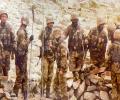
Jaishankar said China, in violation of the 1993 and 1996 agreements not to mass troops on the Line of Actual Control, chose to do so, and added that its attempt was obviously to unilaterally change the LAC.

He said both sides reaffirmed to sincerely work towards complete disengagement of the troops along the LAC.
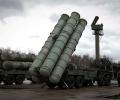
RInstead of disengagement, the Indian and Chinese armies have deployed an estimated 35,000 to 40,000 soldiers each along the LAC. The PLA has deployed S-400 air defence missiles to neutralise the IAF's advantage in air power

In the wake of reported incursion attempts by China, India on Wednesday said such incidents take place due to difference of perception about boundary and leaders of both the countries are in talks to resolve the issue.

In his message to the Buddhist community from his home in McLeodganj, the Tibetan spiritual leader asked people to recite the 'om mani padme hum' mantra. With this practice, you will create some roots of virtue that you can dedicate to me -- Avalakiteshvara's messenger -- to live for 110 or 108 years or so, the Dalai Lama said.

Chinese President Xi Jinping's India visit, starting September 17, may be drawing quite a lot of attention and scrutiny. But many a keen eye will also be trained upon what his better half, Peng Liyuan does during her stay in the country.

The incident took place on Wednesday afternoon in Demchok sector, located 250 km east of Leh, where the work for linking a village with 'hot spring' was being undertaken under the MNREGA.

China's closer and enhanced relationship with Pakistan is putting considerable strain in India-China relations, says former RA&W officer Jayadeva Ranade.

As per the agreement reached by the two sides, India and China will withdraw the forward deployment in a phased and coordinated manner, the defence minister said.
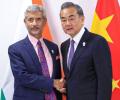
The joint statement said Jaishankar and Wang agreed that both sides should take guidance from the series of consensus reached between leaders of the two countries on developing India-China relations, including not allowing differences to become disputes.

China is the second largest spender on defence after the US. T

The American platforms at the exercise 'Cope India' that started off Kalaikunda will also include a fleet of F-15 E fighter jets, C-130 and C-17 transport aircraft.
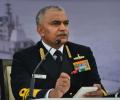
Chief of Naval Staff Admiral Radhakrishnan Hari Kumar said on Friday that his force is fully capable of confronting any security threat and fully backed the ambitious tri-services reforms that included setting up of a maritime theatre command.

The Fujian was launched at a brief ceremony held at the Shanghai shipyard, the official media reported from the eastern metropolis.

The 30-member committee, chaired by senior Bharatiya Janata Party leader and former Union minister Jual Oram and of which Rahul Gandhi is also a member,wishes to visit the eastern Ladakh region in the last week of May or in June.

'These tactics are particularly evident in China's pursuit of its territorial and maritime claims in the South and East China Seas as well as along its border with India and Bhutan'

Giving an account of India's overall military modernisation, Lt Gen Pande also said that an in-principle approval has been given to new combat formations called the Integrated Battle Groups (IBGs) which can mobilise fast with a more effective approach.

'The Chinese are retaining geostrategic pressure on India by keeping troops there and building infrastructure continually.'

Boston Celtics' Kanter sparks backlash in China after comments on Tibet, Xi.
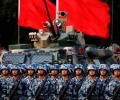
The statements come from a booklet published this month by the state-run People's Publishing House, in which senior officials, including President Xi, outlined the latest five-year plan for the country's development.

Future conflict will involve bypassing of frontiers to strike at critical vulnerabilities directly and in the hinterland at the appropriate time, explains Lieutenant General Anil Chait (retd), who served as chief of the Integrated Defence Staff and Central Army Commander.

'The separatist resurgence in Balochistan is thwarting Pakistan's plans to build CPEC projects to optimally utilise Balochistan's energy reserves,' points out Brigadier Gurmeet Kanwal (retd).

The government must figure out what the Chinese game plan is and thwart the endgame before it is upon us, possibly in early winter, advises David Devadas.

'The MEA, hopefully, made it clear that the Indian PM can't be seen in Xi Jinping's company when China has, for all intents and purposes, annexed over 1,000 sq kms of Indian territory in eastern Ladakh, and essentially that the Wuhan spirit and the Mamallapuram spirit have turned into vinegar.'

Here's a glimpse of all that happened around the world last week, in 10 images
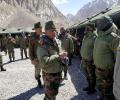
The military preparations underway show that the PLA may undertake operations this summer to achieve whatever objectives they could not achieve last May, asserts Jayadeva Ranade, the distinguished China expert and retired RA&W officer.

The MEA spokesperson further said the actions and behaviour of the Chinese side since earlier this year along the LAC have been in "clear violation" of the bilateral agreements and protocols concluded between the two countries to ensure peace and tranquility on the border.
The intrusions into India were likely carried out by the PLA's better trained and equipped 'mobile operational units'.

Chinese President Xi Jinping, who made a rare visit this week to the restive Xinjiang region which borders Ladakh, met the troops and officers stationed there and praised their "outstanding contributions" to the border defence and stabilisation of the volatile province.
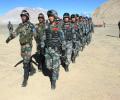
Esper also highlighted the 'increased' military cooperation with India and called it as 'one of the most important defence relationships of the 21th century'.
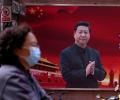
China has not limited the 'battle' to the diplomatic field alone; the People's Liberation Army has become aggressive on the ground too. The recent 'fights' in Northern Sikkim and Ladakh are part of the pattern, asserts Claude Arpi.
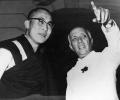
One priority for Delhi (for the new foreign secretary in particular) is to have an in-depth discussion with Dharamsala as soon as possible, suggests Claude Arpi.

China on Monday dodged a direct response to reports of presence of the People's Liberation Army's troops at a forward post in the Pakistan-occupied Kashmir and said it "regretted" that the media keeps "popping up" stories of incursions into the Indian side of the Line of Actual Control.

Situated at a height of 15,200 feet above sea level, the pass sits on the top of a craggily formed Himalayan range that separates the Tibetan plateau from the Indian sub-continent.

China has chosen to keep New Delhi guessing, while retaining for itself the option of constantly changing facts on the ground and shifting the LAC westwards -- the strategy called 'salami slicing', notes Ajai Shukla.

Defence Minister Nirmala Sitharaman had a brief conversation with Chinese soldiers during her maiden visit to the Nathu La border post in Sikkim and was even seen teaching them how to say 'Namaste'.
